alberta gardener
manitoba gardener
ontario gardener
home button what is inside button events button article button cjob button advertise button question button
 

Show from January 15, 2006

Campanula

Good morning gardeners. Well, it's another lovely day this mild, mild winter. And everyone I know is complaining about the warm weather, with our salt-stained pant legs, our filthy cars and the icy streets. I think that underlying all this is a concern about global warning and whether this is just one more indication of disaster lurking around the corner.

But many of you will remember as I do, many mild winters just like this one. I especially recall one very warm winter when I was just a little girl. We were outside playing on dry grass without a sweater in early February. It's all just part of the cycle and with the warming of Pacific waters because of the under-ocean volcanoes that resulted in the Tsunami last year, it is hardly surprising that world weather patterns are affected. And it may still be that we get a cold snap next month.

Regardless, I'm getting ready for spring, at least mentally. And I started thinking yesterday about the family Campanula, known also as bellflower and in Europe as Rampion and Lamb's lettuce. In early spring, the roots and leaves of this particular variety, Campanula rapunculus, are prized in Germany as a salad ingredient.

It was rampion, in fact, that inspired the name Rapunzel in the brothers Grimm fairytale about a woman who saw a bed of the lovely plants in a neighbour's garden and developed such a craving for their taste that she thought she would die if she didn't have some. Her husband obliged, trying to please his pregnant wife. The sorceress who owned the garden caught him stealing the rampion and extracted a promise from him that he would give her the child his wife was carrying. They named the baby Rapunzel, she of the golden hair. When Rapunzel was 12, she was locked away in a tower by the witch who wanted to keep the girl's beauty to herself. The only entrance to the tower was by way of climbing the long gold tresses of the girl and the witch would call out, "Rapunzel, Rapunzel, let down thy golden hair". whenever she wanted to visit. Well, you know the rest. A king overheard this and when the witch was away, he came to visit and after a number of mishaps, (including blindness and a pair of twins), he of course took her to live with him happily ever after.

But back to the plant. Campanula grows commonly all over the northern hemisphere as annuals, perennials and even some biennials. The varieties we most often see here include the clustered bellflower, Campanula glomerata, which has cluster of pretty purple growing from the ends of the leafy stems. This is a fairly rampant plant once its roots are well established that will spread far and wide if you let it.

There is also Campanula rotundifolia, the bluebell of Scotland, with its light blue downward facing blossoms that grow on slender stalks about one to two feet tall.

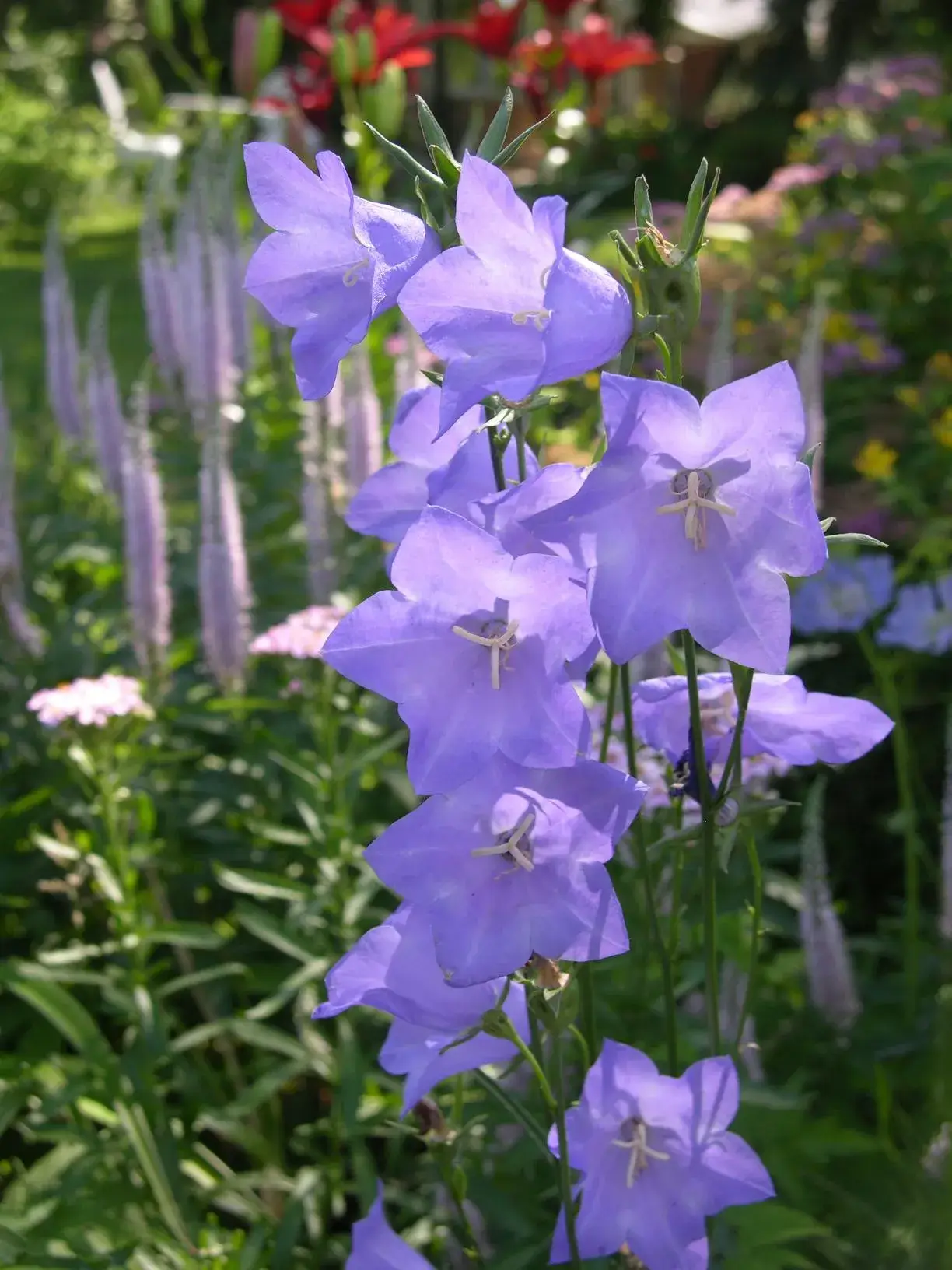
And there are the small, mounded 6-inch, delicate Campanula carpatica, White Clips and Blue Clips, just perfect for the edge of the garden. We also grow Campanula persicifolia, the peach leafed bellflower, a taller plant in white or blue that can come in single or double blossoms as can the taller Campanula trachelium which has bristly stems. This variety can also be fairly aggressive.

But the most prized campanulas to my mind are the outward facing cup and saucer or Canterbury bells varieties with their double flowers. They are generally rated zone 5, although I have seen them thriving in Lac du Bonnet. These lovely flowers have double blossoms that arranged to look like a cup sitting on a saucer.

There are also a number of hybrid cultivars of the downward facing variety, Campanula punctata, a couple of which are supposed to be marginally hardy here, although they are rated zone 5. I put in one called Campanula Milkshake last year and I will let you know if it made it through the winter. It is a nice little plant that bloomed most of the summer. It's about 18 inches tall with downward facing bells in a milky pinky shade.

Well, I have barely scratched the surface of this plant family. They come in blues, whites, pinks, purples and there is even a gold-leafed or lime green variety, hardy to zone five, called Disckson's Gold.

They like to grow in partial shade and prefer a well watered, but well drained site. The carpaticas are rock garden plants, the others come from woodland margins. It's a lovely plant family. Enjoy them.